Monday, 7 March 2011

Antarctica


Antarctica, fifth largest of the Earth’s seven continents. The southernmost, coldest, windiest, highest, most remote, and most recently discovered continent, it surrounds the South Pole, the point at the southern end of the Earth’s axis. Almost completely covered by ice, Antarctica has no permanent human population. The continent is ringed by the Southern, or Antarctic, Ocean, a body of water made up of the southern portions of the Atlantic, Pacific, and Indian oceans but sometimes considered a separate ocean due to its lower temperature and salt concentration. The entire area south of the Antarctic Convergence, the zone where the Southern Ocean meets the other oceans, is referred to as the Antarctic region. Antarctica means “opposite to the Arctic,” the Earth’s northernmost region.
The continent is shaped somewhat like a comma, with a round body surrounding the pole and a tail curving toward South America. The round portion, lying mainly in the Eastern Hemisphere, makes up East Antarctica. The tail and its thickened base, located entirely in the Western Hemisphere, form West Antarctica. Antarctica lies 1,000 km (600 mi) from South America, its nearest neighbor; 4,000 km (2,500 mi) from Africa; and 2,500 km (1,600 mi) from Australia. Antarctica’s latitude (location in relation to the equator) and high elevations make it the coldest continent. Air temperatures of the high inland regions fall below –80°C (-110°F) in winter and rise only to –30°C (–20°F) in summer. The warmest coastal regions reach the freezing point in summer but drop well below in winter.
The last continent to be discovered, Antarctica remained hidden behind barriers of fog, storm, and sea ice until it was first sighted in the early 19th century. Because of the extreme cold and the lack of native peoples, forests, land animals, and obvious natural resources, the continent remained largely neglected for decades after discovery. Scientific expeditions and seal hunters had explored only fragments of its coasts by the end of the 19th century, while the interior remained unknown. Explorers first reached the South Pole in 1911, and the first permanent settlements—scientific stations—were established in the early 1940s. From that time the pace of exploration accelerated rapidly. Scientists continue to conduct research in Antarctica, and in recent years increasing numbers of tourists have visited Antarctica to appreciate the region’s majestic scenery and wildlife.
Seven nations—Argentina, Australia, Britain, Chile, France, New Zealand, and Norway—claim territory in Antarctica. Other nations, including the United States and Russia, do not acknowledge these claims and make no claims of their own, but reserve rights to claim territory in the future. Since 1961 the continent has been administered under the Antarctic Treaty, an international agreement to preserve the continent for peaceful scientific study.

Australia


Australia, island continent located southeast of Asia and forming, with the nearby island of Tasmania, the Commonwealth of Australia, a self-governing member of the Commonwealth of Nations. The continent is bounded on the north by the Timor Sea, the Arafura Sea, and the Torres Strait; on the east by the Coral Sea and the Tasman Sea; on the south by the Bass Strait and the Indian Ocean; and on the west by the Indian Ocean. The commonwealth extends about 4,000 km (about 2,500 mi) from east to west and about 3,700 km (about 2,300 mi) from north to south. The area of the commonwealth is 7,682,300 sq km (2,966,200 sq mi), and the area of the continent alone is 7,614,500 sq km (2,939,974 sq mi), making Australia the smallest continent in the world, but the sixth largest country. The capital of Australia is Canberra, and the largest city is Sydney; both are located in the southeast.
The Commonwealth of Australia is made up of six states—New South Wales, Queensland, South Australia, Tasmania, Victoria, and Western Australia—and two territories—the Australian Capital Territory and the Northern Territory. The external dependencies of Australia are the Territory of Ashmore and Cartier Islands, the Australian Antarctic Territory, Christmas Island, the Territory of Cocos Islands (also called the Keeling Islands), the Coral Sea Islands Territory, the Territory of Heard Island and McDonald Islands, and Norfolk Island.
The first inhabitants of Australia were the Aboriginal people, who migrated to the continent some 50,000 to 60,000 years ago. The continent remained relatively unknown to most of the outside world until the 17th century. The first permanent European settlement was established in 1788 at Port Jackson, in southeastern Australia, as a British penal colony; it grew into the city of Sydney. Australia developed as a group of British colonies during the 19th century, and in 1901 the colonies federated to form a unified independent nation, the Commonwealth of Australia.

Africa


Africa, second largest of Earth’s seven continents, covering 23 percent of the world’s total land area and containing 13 percent of the world’s population. Africa straddles the equator and most of its area lies within the tropics. It is bounded by the Atlantic Ocean on the west, the Indian Ocean and Red Sea on the east, and the Mediterranean Sea on the north. In the northeastern corner of the continent, Africa is connected with Asia by the Sinai Peninsula.
Africa is a land of great diversity. If you were to trek across the continent, you would pass through lush, green forests and wander vast, grassy plains. You would cross barren deserts, climb tall mountains, and ford some of the mightiest rivers on Earth. You would meet diverse people with a wide range of cultures and backgrounds and hear hundreds of different languages. You would pass through small villages where daily life remains largely the same as it has been for hundreds of years, as well as sprawling cities with skyscrapers, modern economies, and a mix of international cultural influences.
Africa is the birthplace of the human race. Here, early humans evolved from apes between 8 million and 5 million years ago. Modern human beings evolved between 130,000 and 90,000 years ago, and subsequently spread out of Africa. Ancient Egypt, one of the world’s first great civilizations, arose in northeastern Africa more than 5,000 years ago. Over time many other cultures and states rose and fell in Africa, and by 500 years ago there were prosperous cities, markets, and centers of learning scattered across the continent.
During the last 500 years, however, Africa became increasingly dominated by European traders and colonizers. European traders sent millions of Africans to work as slaves on colonial plantations in North America, South America, and the Caribbean. Europeans also sought Africa’s wealth of raw materials to fuel their industries. In the late 19th century, European powers seized and colonized virtually all of Africa.
Through slow reform or violent struggle, most of Africa won independence in the 1950s and 1960s. Independent Africa inherited from colonization a weak position in the global economy, underdeveloped communication and transportation systems, and arbitrarily drawn national boundaries. The citizens of these new nations generally had little in terms of history or culture to bind them together.
There are 53 different African countries, including the 47 nations of the mainland and the 6 surrounding island nations. The continent is commonly divided along the lines of the Sahara, the world’s largest desert, which cuts a huge swath through the northern half of the continent. The countries north of the Sahara make up the region of North Africa, while the region south of the desert is known as sub-Saharan Africa. Sub-Saharan Africa is sometimes referred to as “Black Africa,” but this designation is not very helpful, given the ethnic diversity of the entire continent. North Africa consists of the countries of Algeria, Egypt, Libya, Morocco, Sudan, and Tunisia. Sub-Saharan Africa is generally subdivided into the regions of West Africa, East Africa, Central Africa, and southern Africa. For the purposes of this article, West Africa consists of Benin, Burkina Faso, Cameroon, Chad, Côte d’Ivoire, Ghana, Guinea, Guinea-Bissau, Liberia, Mali, Mauritania, Niger, Nigeria, Senegal, Sierra Leone, The Gambia, and Togo. East Africa consists of Burundi, Djibouti, Eritrea, Ethiopia, Kenya, Malawi, Mozambique, Rwanda, Somalia, Tanzania, and Uganda. Central Africa consists of Angola, Central African Republic, Democratic Republic of the Congo, Equatorial Guinea, Gabon, Republic of the Congo, and Zambia. Southern Africa consists of Botswana, Lesotho, Namibia, South Africa, Swaziland, and Zimbabwe. The island nations located off the coast of Africa are Cape Verde and São Tomé and Príncipe in the Atlantic Ocean; and Comoros, Madagascar, Mauritius, and Seychelles in the Indian Ocean.

South America


South America, fourth largest of the Earth's seven continents (after Asia, Africa, and North America), occupying 17,820,900 sq km (6,880,700 sq mi), or 12 percent of the Earth's land surface. It lies astride the equator and tropic of Capricorn and is joined by the Isthmus of Panama, on the north, to Central and North America. The continent extends 7,400 km (4,600 mi) from the Caribbean Sea on the north to Cape Horn on the south, and its maximum width, between Ponta do Seixas, on Brazil's Atlantic coast, and Punta Pariñas, on Peru's Pacific coast, is 5,160 km (3,210 mi).
South America has a 2004 estimated population of 369 million, or 6 percent of the world's people. The continent comprises 12 nations. Ten of the countries are Latin: Argentina, Bolivia, Brazil, Chile, Colombia, Ecuador, Paraguay, Peru, Uruguay, and Venezuela. Two of the nations are former dependencies: Guyana, of the United Kingdom, and Suriname, of The Netherlands. South America also includes French Guiana, an overseas department of France. Located at great distances from the continent in the Pacific Ocean are several territories of South American republics: the Juan Fernández Islands and Easter Island (Chile) and the Galápagos Islands (Ecuador). Nearer the coast, in the Atlantic Ocean, is the Fernando de Noronha Archipelago, which is a Brazilian territory, and, farther south, the British dependency of the Falkland Islands, which is claimed by Argentina as the Islas Malvinas. The coastline of South America is relatively regular except in the extreme south and southwest, where it is indented by numerous fjords.

North America


North America, third largest of the seven continents, including Canada (the 2nd largest country in area in the world), the United States (3rd largest), and Mexico (14th largest). The continent also includes Greenland, the largest island, as well as the small French overseas department of Saint-Pierre and Miquelon and the British dependency of Bermuda (both made up of small islands in the Atlantic Ocean). With more than 405 million inhabitants estimate), North America is the 4th most populous continent; the United States ranks 3rd and Mexico 11th in population among the world's countries. Canada and the United States have technologically developed early modern economies, and Mexico, although less technologically developed than its neighbors, contains some of the world's greatest deposits of petroleum and natural gas.
Together with Central America, the West Indies, and South America, North America makes up the Western Hemisphere of Earth. North America is sometimes defined to include Central America and the West Indies, which are treated separately in Encarta Encyclopedia. The name America is derived from that of Italian navigator Amerigo Vespucci, who may have visited the mainland of North America in 1497 and 1498.

EUROPE


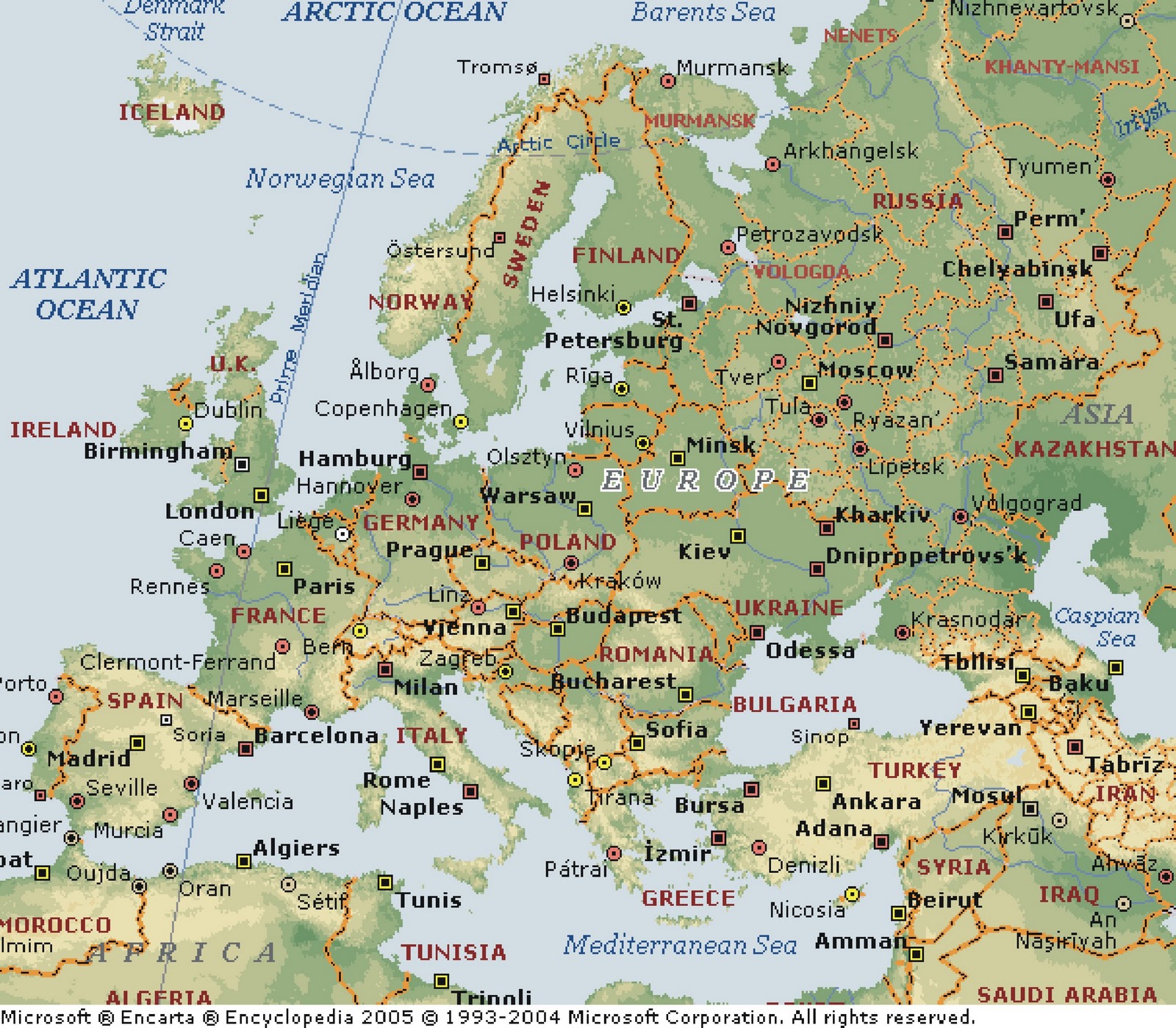
Europe, conventionally one of the seven continents of the world. Although referred to as a continent, Europe is actually just the western fifth of the Eurasian landmass, which is made up primarily of Asia. Modern geographers generally describe the Ural Mountains, the Ural River, part of the Caspian Sea, and the Caucasus Mountains as forming the main boundary between Europe and Asia. The name Europe is perhaps derived from that of Europa, the daughter of Phoenix in Greek mythology, or possibly from Ereb, a Phoenician word for “sunset.”
The second smallest continent (Australia is the smallest), Europe has an area of 10,355,000 sq km (3,998,000 sq mi), but it has the third largest population of all the continents, 729 million in 2004. The northernmost point of the European mainland is Cape Nordkinn, in Norway; the southernmost, Punta de Tarifa, in southern Spain near Gibraltar. From west to east the mainland ranges from Cabo da Roca, in Portugal, to the northeastern slopes of the Urals, in Russia.
Europe has long been a center of great cultural and economic achievement. The ancient Greeks and Romans produced major civilizations, famous for their contributions to philosophy, literature, fine art, and government. The Renaissance, which began in the 14th century, was a period of great accomplishment for European artists and architects, and the age of exploration, beginning in the 15th century, included voyages to new territories by European navigators. European nations, particularly Spain, Portugal, France, and Britain, built large colonial empires, with vast holdings in Africa, the Americas, and Asia. In the 18th century modern forms of industry began to be developed. In the 20th century much of Europe was ravaged by the two world wars. After World War II ended in 1945, the continent was divided into two major political and economic blocs—Communist nations in Eastern Europe and non-Communist countries in Western Europe. Between 1989 and 1991, however, the Eastern bloc broke up. Communist regimes surrendered power in most Eastern European countries. East and West Germany were unified. The Soviet Communist Party collapsed, multilateral military and economic ties between Eastern Europe and the Union of Soviet Socialist Republics (USSR) were severed, and the USSR itself ceased to exist.

Saturday, 5 March 2011

WORLD


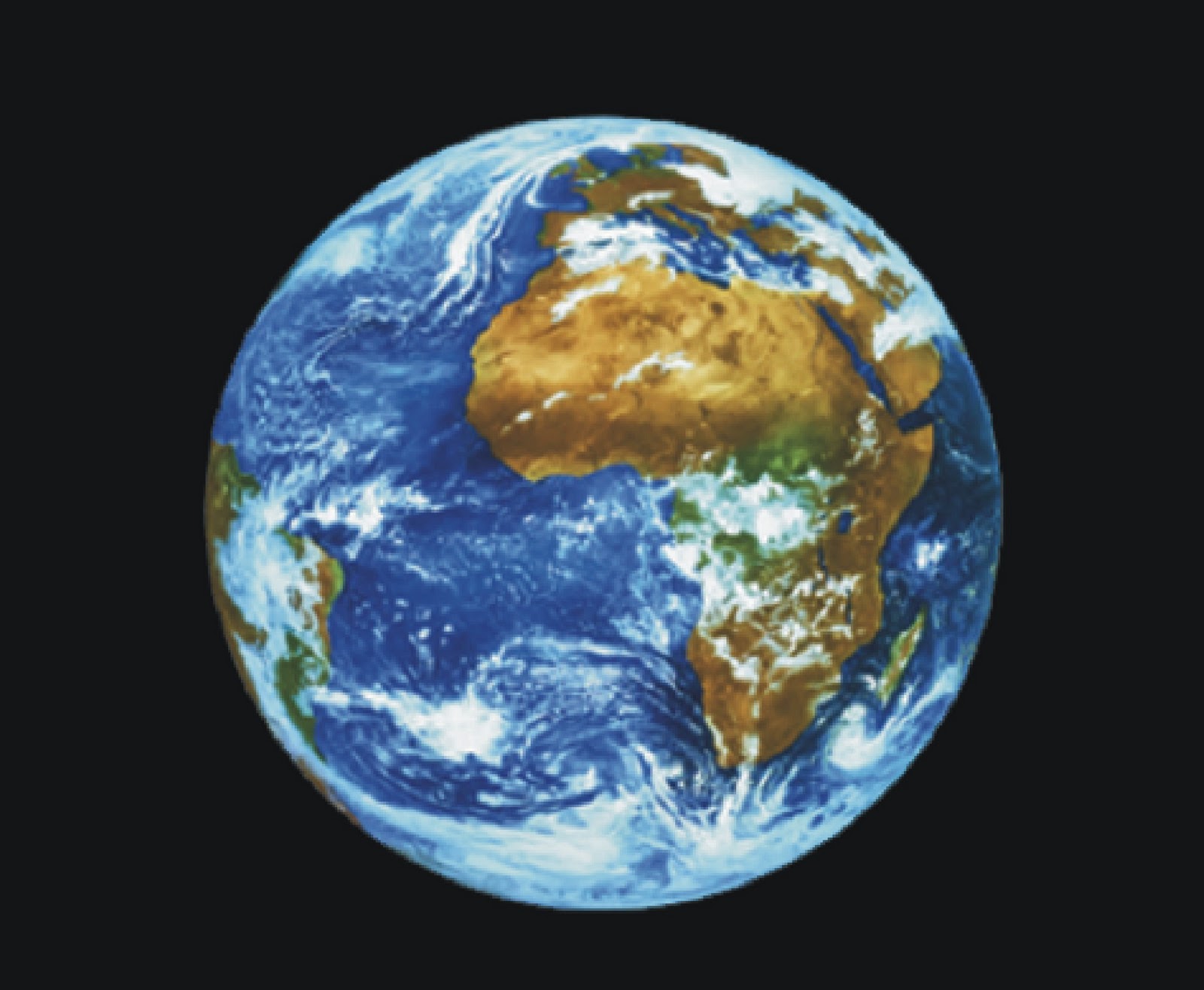
Earth (planet), one of nine planets in the solar system, the only planet known to harbor life, and the “home” of human beings. From space Earth resembles a big blue marble with swirling white clouds floating above blue oceans. About 71 percent of Earth’s surface is covered by water, which is essential to life. The rest is land, mostly in the form of continents that rise above the oceans.
Earth’s surface is surrounded by a layer of gases known as the atmosphere, which extends upward from the surface, slowly thinning out into space. Below the surface is a hot interior of rocky material and two core layers composed of the metals nickel and iron in solid and liquid form.
Unlike the other planets, Earth has a unique set of characteristics ideally suited to supporting life as we know it. It is neither too hot, like Mercury, the closest planet to the Sun, nor too cold, like distant Mars and the even more distant outer planets—Jupiter, Saturn, Uranus, Neptune, and tiny Pluto. Earth’s atmosphere includes just the right amount of gases that trap heat from the Sun, resulting in a moderate climate suitable for water to exist in liquid form. The atmosphere also helps block radiation from the Sun that would be harmful to life. Earth’s atmosphere distinguishes it from the planet Venus, which is otherwise much like Earth. Venus is about the same size and mass as Earth and is also neither too near nor too far from the Sun. But because Venus has too much heat-trapping carbon dioxide in its atmosphere, its surface is extremely hot—462°C (864°F)—hot enough to melt lead and too hot for life to exist.
Although Earth is the only planet known to have life, scientists do not rule out the possibility that life may once have existed on other planets or their moons, or may exist today in primitive form. Mars, for example, has many features that resemble river channels, indicating that liquid water once flowed on its surface. If so, life may also have evolved there, and evidence for it may one day be found in fossil form. Water still exists on Mars, but it is frozen in polar ice caps, in permafrost, and possibly in rocks below the surface.
For thousands of years, human beings could only wonder about Earth and the other observable planets in the solar system. Many early ideas—for example, that the Earth was a sphere and that it traveled around the Sun—were based on brilliant reasoning. However, it was only with the development of the scientific method and scientific instruments, especially in the 18th and 19th centuries, that humans began to gather data that could be used to verify theories about Earth and the rest of the solar system. By studying fossils found in rock layers, for example, scientists realized that the Earth was much older than previously believed. And with the use of telescopes, new planets such as Uranus, Neptune, and Pluto were discovered.
In the second half of the 20th century, more advances in the study of Earth and the solar system occurred due to the development of rockets that could send spacecraft beyond Earth. Human beings were able to study and observe Earth from space with satellites equipped with scientific instruments. Astronauts landed on the Moon and gathered ancient rocks that revealed much about the early solar system. During this remarkable advancement in human history, humans also sent unmanned spacecraft to the other planets and their moons. Spacecraft have now visited all of the planets except Pluto. The study of other planets and moons has provided new insights about Earth, just as the study of the Sun and other stars like it has helped shape new theories about how Earth and the rest of the solar system formed.
As a result of this recent space exploration, we now know that Earth is one of the most geologically active of all the planets and moons in the solar system. Earth is constantly changing. Over long periods of time land is built up and worn away, oceans are formed and re-formed, and continents move around, break up, and merge.
Life itself contributes to changes on Earth, especially in the way living things can alter Earth’s atmosphere. For example, Earth at one time had the same amount of carbon dioxide in its atmosphere as Venus now has, but early forms of life helped remove this carbon dioxide over millions of years. These life forms also added oxygen to Earth’s atmosphere and made it possible for animal life to evolve on land.
A variety of scientific fields have broadened our knowledge about Earth, including biogeography, climatology, geology, geophysics, hydrology, meteorology, oceanography, and zoogeography. Collectively, these fields are known as Earth science. By studying Earth’s atmosphere, its surface, and its interior and by studying the Sun and the rest of the solar system, scientists have learned much about how Earth came into existence, how it changed, and why it continues to change.